As a specifying engineer, your decisions carry significant weight. Selecting the right equipment isn’t just about meeting a project’s immediate needs; it’s about ensuring long-term performance, managing costs, and guaranteeing regulatory compliance. When it comes to treating oily wastewater, the choice between an above-grade and a below-grade oil water separator is a critical juncture where the wrong turn can lead to costly maintenance headaches and serious violations.
This decision isn’t based on preference. It’s a technical evaluation driven by site-specific conditions, flow characteristics, and operational demands. This article provides a definitive breakdown of the differences, applications, and core decision-making criteria for each separator type, empowering you to specify with confidence.
Key Takeaways
- Above Grade Separators: Best for pump-feed applications where easy access for maintenance is a priority and a physical footprint is available.
- Below Grade Separators: The go-to solution for gravity-flow systems, high-traffic “drive-over” areas, and sites where conserving surface space is critical.
- Core Decision Factors: The final choice hinges on a technical evaluation of flow type (pumped vs. gravity), site conditions, maintenance protocols, and installation budget.
- Compliance is Paramount: Selecting the correct and properly sized separator is a non-negotiable first step to meeting EPA discharge limits and avoiding fines.
Understanding the Core OWS Categories
At their core, both separator types are designed to remove hydrocarbons from wastewater. However, their physical design dictates their specific application and installation environment.
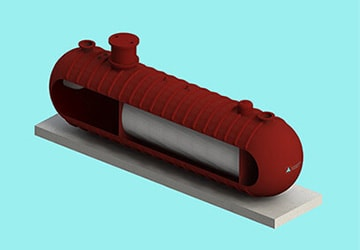
An Above Grade oil water separator is a self-contained unit installed on a prepared surface, such as a concrete pad. It is ideal for treating wastewater that is collected and moved from a pumped source.
A Below Grade separator is a unit installed underground, often flush with the surface. These systems are engineered to integrate with gravity-fed drainage systems and are built to withstand the immense loads from burial and vehicle traffic.
Understanding the full range of performance-proven oil water separators is the first step in selecting the right system for your needs.
At a Glance: Above Grade vs. Below Grade Comparison
| Criteria | Above Grade Separator | Below Grade Separator |
| Installation | Requires surface pad preparation; relatively simple. | Major excavation, shoring, and certified backfilling required. |
| Footprint | Requires a dedicated surface area for the unit. | Preserves 100% of the surface area for other uses. |
| Flow Type | Designed for pumped-feed systems. | Engineered specifically for gravity flow systems. |
| Maintenance & Access | Easy, direct access to all components and internals. | Limited access via manholes/risers; may require confined space entry. |
| Typical Upfront Cost | Lower installation costs due to less site work. | Higher installation costs due to significant civil work. |
The Case for Above Grade Oil Water Separators
Above-grade units are the preferred solution when accessibility and installation simplicity are primary project drivers. Their straightforward design offers distinct advantages in controlled environments.
Advantages of Above Grade OWS
- Simplified Maintenance & Inspection: The most significant benefit is unparalleled access. All components, from coalescing media to oil and solids reservoirs, are directly accessible, streamlining routine clean-outs and inspections without needing confined space entry protocols.
- Lower Installation Costs: These units avoid the substantial expenses tied to excavation, soil disposal, crane services, and heavy civil work. Installation typically involves preparing a concrete pad and connecting the inlet and outlet piping.
- Installation Flexibility: An above-grade separator is easier to integrate into existing above-ground piping networks. Furthermore, if facility operations change or expand, these units can often be relocated with far less difficulty than an underground system.
Disadvantages and Considerations
- Requires Physical Footprint: The unit consumes valuable floor or ground space. In a crowded industrial facility or a compact commercial site, dedicating this area can be a significant drawback.
- Exposure to Elements: When installed outdoors, the separator is exposed to weather. In colder climates, this may necessitate an insulated enclosure or internal heating elements to prevent freezing and ensure optimal separation efficiency.
- Aesthetic Impact: A visible industrial tank can be visually obtrusive, making it a less suitable choice for public-facing commercial sites like retail centers or office parks where aesthetics are a concern.
Ideal Applications
- Industrial Manufacturing Facilities: Perfect for indoor applications where process water, machine coolant, or wash-down water is collected in sumps and pumped to a central treatment point.
- Vehicle & Equipment Maintenance Garages: A common choice for shops where oily wastewater from floor drains is collected and then pumped to the separator before discharge.
- Temporary Job Sites: For construction, mining, or modular facilities, an above-grade unit provides effective treatment without the commitment of a permanent underground installation.
When to Specify Below-Grade Oil-Water Separators
For projects where surface space is a premium or the site demands a rugged, out-of-sight solution, a below-grade separator is the clear engineering choice.
Advantages of Below Grade OWS
- Zero Surface Footprint: By installing the unit underground, you preserve valuable land for parking, driving lanes, or other operational activities. This maximizes the utility of the site, a critical factor in dense commercial or industrial developments.
- Optimized for Gravity Flow: These separators are designed to integrate seamlessly into site-wide drainage plans that use natural gradients. They become a natural collection point for stormwater runoff and other gravity-fed waste streams.
- Superior Durability and Protection: When made from the highest quality materials to ensure structural integrity, these units are inherently protected. They are safe from vehicle collisions, weather extremes, and daily operational damage that an exposed unit might face.
Disadvantages and Considerations
- Complex and Costly Installation: The upfront investment is significantly higher due to the required civil work. This includes major excavation, potential dewatering for sites with high water tables, shoring for safety, and using certified backfill material to prevent structural damage.
- Challenging Maintenance Access: All service is performed through manholes or access risers. Inspections and clean-outs often require specialized vacuum trucks and demand strict adherence to confined space safety protocols, increasing operational complexity and cost.
- Potential Site Complications: Unforeseen site issues, such as difficult soil conditions, underground utilities, or a high water table, can further complicate the installation process and escalate the overall project budget.
Ideal Applications
- High-Traffic Areas: Gas stations, airports, military bases, and truck stops where “drive-over” durability is essential to handle constant, heavy vehicle loads.
- Vehicle Washing Facilities: Car and truck washes generate significant oily runoff that is typically collected in a network of gravity-fed trench drains, making a below-grade unit the logical choice.
- Large-Scale Sites: Large industrial plants, municipal collection systems, and expansive parking lots that must manage high flow rates (GPM) of oily stormwater runoff without consuming surface space.
Navigating Compliance: Regulations You Can’t Ignore
Properly specifying an oil water separator is not an operational preference; it is a foundational requirement for environmental compliance. Federal, state, and local regulations govern the discharge of oily wastewater, and failure to comply carries severe consequences.
According to the EPA, non-compliance with oily wastewater discharge regulations can result in severe penalties for negligent violations. While federal frameworks like the Clean Water Act set the national standard, it’s crucial to remember that local municipal discharge limits (set by the Publicly Owned Treatment Works, or POTW) are often even stricter.
Additionally, for facilities that store significant quantities of oil, the EPA’s Spill Prevention, Control, and Countermeasure (SPCC) rule is a factor. As one report on the SPCC rule notes, OWS units must be included in oil storage capacity calculations, making their presence and function integral to the facility’s overall compliance plan.
Your Decision Framework: Choosing the Right Separator
- Question 1: What is your flow type? This is the primary dividing line. If your wastewater collection system is gravity-fed, a below-grade system is engineered for the job. If wastewater is collected in a sump and pumped for treatment, an above-grade unit is the logical choice.
- Question 2: What are your site conditions? Is surface space at a premium? Is the separator located in an area subject to frequent or heavy vehicle traffic? A “yes” to either of these questions strongly indicates a Below Grade solution is necessary to preserve space and ensure durability.
- Question 3: What are your maintenance protocols? Consider the facility’s operational capabilities. If easy, frequent visual inspection and direct access are top priorities, and confined space entry is a significant barrier, lean towards an Above Grade unit.
- Question 4: What are your sizing requirements? This applies to both types. Once you’ve determined the category, you must ensure the model is correctly sized for the peak flow rate (GPM) to prevent hydraulic overload, which can cause bypass and lead to non-compliant discharge.
Conclusion: Specifying with Confidence
The decision between an above-grade and below-grade oil water separator hinges on a clear trade-off. Above-grade units offer superior accessibility and lower installation costs, making them ideal for controlled, pump-fed applications. In contrast, below-grade separators deliver unmatched space efficiency and durability, making them essential for gravity-fed systems in high-traffic or space-constrained environments.
The best choice is never about which separator is inherently superior, but about precisely aligning the separator’s design with the project’s specific operational, spatial, and regulatory demands. Partnering with experts in oil water separators is the surest way to get a correctly specified, compliant, and long-lasting solution that protects both your project and the environment.
