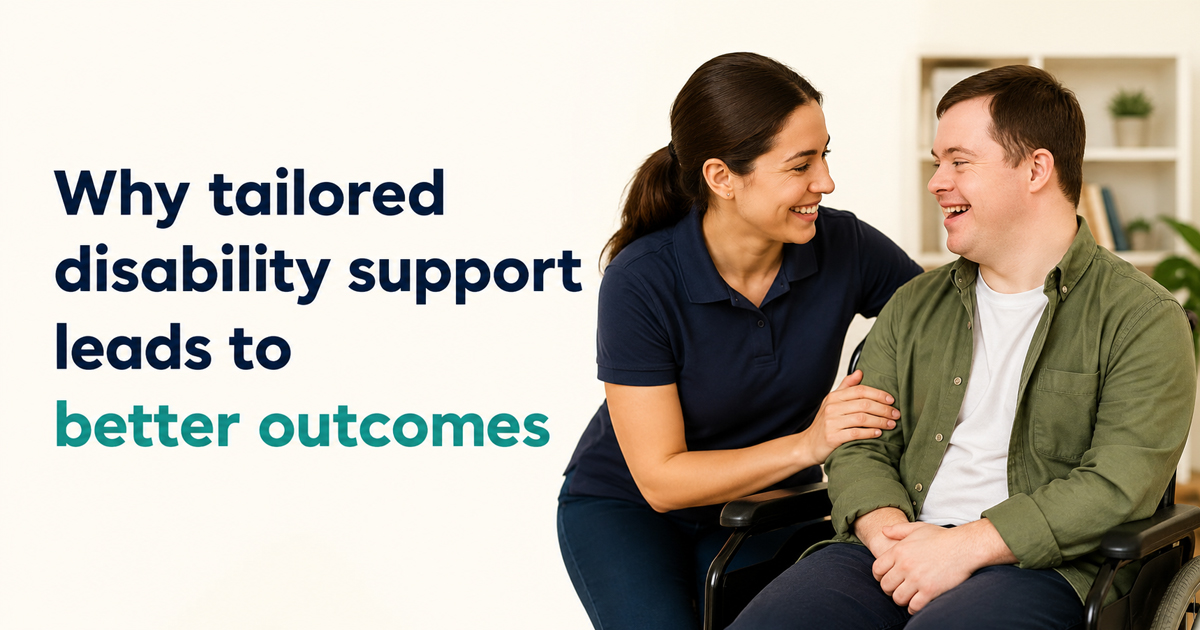
Two people can have nearly identical NDIS plans, the same funded hours, the same support category, and still need completely different things from a support worker. We see it every week. One participant wants someone who turns up, helps with the shower, and gets out of the way. Another wants the worker to sit down for ten minutes first, because the morning goes better when it doesn’t feel rushed. Same plan on paper. Very different days.
That gap is the whole case for tailored support. “Person-centred” gets printed on nearly every disability support provider‘s website in the country, so the phrase has stopped meaning much. What actually changes outcomes is whether the support is shaped around the person or shaped around a roster.
Generic support fills hours. Tailored support moves you somewhere.
Every NDIS plan has a finite number of funded hours, and you can spend them two ways. The first is to have a worker show up and complete tasks. Tick, tick, done. The supports happen and there’s nothing wrong with it on the surface. The second uses the exact same hours to chip away at something you’re trying to reach, whether that’s getting confident on public transport, keeping your place clean without it overwhelming you, or getting out of the house more than once a week.
A good NDIS provider treats your plan goals as the actual point, not the paperwork that sits behind the service. The hours are identical either way. What you get out of them is not.
The worker match matters more than almost anything else
Personal care shows this most clearly. You’re letting someone into the most private part of your day, helping you shower, dress, and manage medication. If that person rushes you, does things in an order that doesn’t suit you, or you just don’t warm to them, the support still technically happens. But you start dreading the knock at the door, and people who dread their support tend to cancel it.
When we take on a new participant, we spend time on the boring questions first. What time do you want to start? Shower in the morning or at night? Any foods you can’t stand? Does someone call you at a set time each day? Then we match you to a worker around those answers, and we keep the same worker with you wherever we can. Consistency is underrated. A worker who’s been with you a few months knows that Thursdays are harder, that you like the kettle on before anything else happens, and that you don’t really need help with the dishes, you just like the company while you do them. A different stranger every week never learns any of that.
If a match isn’t working, we change it. You’re never stuck with a worker you’re not comfortable with, and a registered NDIS provider should make that easy rather than awkward.
Doing with you, not just doing for you
There’s a version of disability support that quietly makes people more dependent. The worker does everything, quickly and well, and over months the participant loses the small skills they did have because they never get used. Tailored support watches for this. Sometimes the goal genuinely is to take a task off your plate so you can spend your energy elsewhere, and that’s a fine outcome. But often the better one is doing the task together so the skill stays, or grows.
NDIS Domestic assistance is a good example. One participant wants the place cleaned while they’re out, no fuss. Another wants to cook alongside the worker so they’re slowly building toward managing meals on their own. Same service line, opposite approaches, and both are right because they match what the person actually wants. A provider that only offers one mode isn’t tailoring anything.
Tailored support produces better evidence at plan reviews
Here’s a practical payoff people don’t think about until review time. The NDIS wants to see that your funding is helping you move toward your goals. If your support has been generic, the report at review reads generic too: hours delivered, tasks completed. If your support was built around specific goals, the evidence almost writes itself. You went from needing a worker on every bus trip to managing the run to Mount Druitt station on your own. That kind of detail helps you hold onto funding, and sometimes makes the case for more of it.
We’re not support coordinators, but we do give participants clear records of what we’ve worked on and how it’s tracking against their goals, because that’s the information that’s actually useful when a plan comes up for review.
Local knowledge is part of the tailoring
Support that fits the person also has to fit where they live. We’re based in Lethbridge Park and most of our work runs across Mount Druitt, Blacktown, Penrith, Emerton, and the suburbs around them. That matters in ordinary, practical ways. Our workers know which entrance at Blacktown Hospital is easiest with a wheelchair, that Nurragingy Reserve in Doonside has flat accessible paths and quiet corners for someone who gets overwhelmed in crowds, and roughly how long the drive to Nepean takes when the school traffic hits.
A disability support provider running workers out of an office 40 minutes away can cover the area on paper. But they’re guessing at the things a local team just knows, and that guesswork shows up in scheduling, travel time, and how flexible they can be when your week changes at short notice.
What to ask before you commit
If you’re weighing up providers, a few questions sort the genuinely tailored ones from the rest:
- How do you match workers to participants, and what happens if it isn’t a good fit?
- Will I have the same worker most weeks, or whoever happens to be free?
- How do you track progress against my plan goals?
- Are you actually based near me, or covering my suburb from somewhere else?
- Are you a registered NDIS provider, and what’s your registration number?
That last one is worth checking for yourself. You can look up any registered NDIS provider on the NDIS Quality and Safeguards Commission register. Registration means the provider has been audited against the NDIS Practice Standards and can work with agency managed, plan managed, and self managed participants.
Lucky Support Solutions is a registered NDIS provider based in Lethbridge Park, NSW, serving Western Sydney. This article is general information, not official NDIS guidance.
